2D Animation Project
In this project i am going to be discussing my ethical subject of choice for my created 2D animation, its purpose, as well as providing background research into my chosen topic, discussing the target audience, followed by storyboard analysis, a visual treatment of the animation (Tufte’s Principles) , and animation history that has influenced this project.
Ethical Or Sustainable Subject
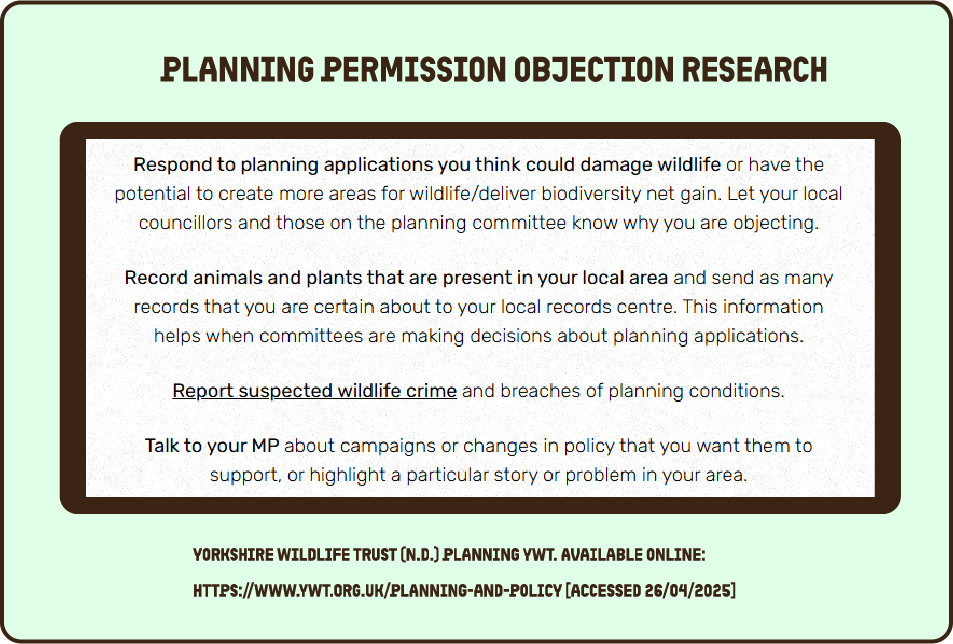
“Habitat loss – development can cause the loss of wildlife habitats like woodland, grasslands or ponds.
Note that wildlife can use different habitats for feeding, breeding and rest, and can use different habitats at different times of year, or for different parts of their life cycle. Just because a habitat isn’t used all the time doesn’t mean it isn’t important for wildlife.” (Wildlife Trust Wales (N.D.) How Wildlife Can Be Harmed By Development)
The chosen subject for my 2D animation is the negative effects of overdevelopment on animals and the environment and planning permission objection awareness. I will be painting my own background scenery for the animation due to inspirations such as Studio Ghibli and Kazuo Oga.
Wildlife Trust states that development leads to loss of wildlife habitats such as woodland, grassland, or ponds, which forces animals out of their natural homes.
Overdevelopment is rapidly reducing the natural environment, replacing it with man made structures such as houses and shops, and doesn’t consider the needs of animals who already live there.

Background Research
According to a paper by Wayne C. Zipperer, Robert Northrop, Michael Andreu, on Urban Development and Environmental Degradation, the overdevelopment of land and habitat loss is one of the greatest threats to biodiversity, forcing animals to go from “urban avoiders” to “urban dwellers”, as well as stating:
“roads and other urban features isolate populations causing local extinctions, limit dispersal among populations, increase mortality rates, and aid in the movement of invasive species.” (Wayne C. Zipperer, et al. 2020)
It can be seen that the effects of overdevelopment on nature and animals is obtusely negative, and is especially relevant the the area which i live, which i grew up in, which is being rapidly overdeveloped. Due to this, we are seeing the loss of more and more countryside each year.
Audience
Due to the style of the animation, and my inspirations from Studio Ghibli, which was founded in 1985 , and artist Kazuo Oga, the target audience is millennials and Gen Z, who grew up with these famous animations praised for their stunning portrayal of the natural world, such as My Neighbour Totoro (1988), Princess Mononoke (1997), Spirited Away (2001), The Cat Returns (2002), Howl’s Moving Castle (2004). (The Studio Ghibli Collection Presented By GKIDS)
Purpose
The purpose of this animation will be to bring awareness to the 2011 Localism Act (YWT (N.D.) Addressing Wildlife In Neighbourhood Plans pdf) , which allows communities to create a neighbourhood plan, which gives them some power to shape development in their area, as well as bringing attention to how overdevelopment is damaging the earth,the animals, and to challenge the misguided view that nature is disposable, and solely there to serve people, rather than the symbiotic relationship we are all a part of. I will convey this using beauty through hand painted backgrounds, and provoke people to think a bit more about buildings being put up around them, and the effects they have on wildlife.
Conceptual Transition Planning
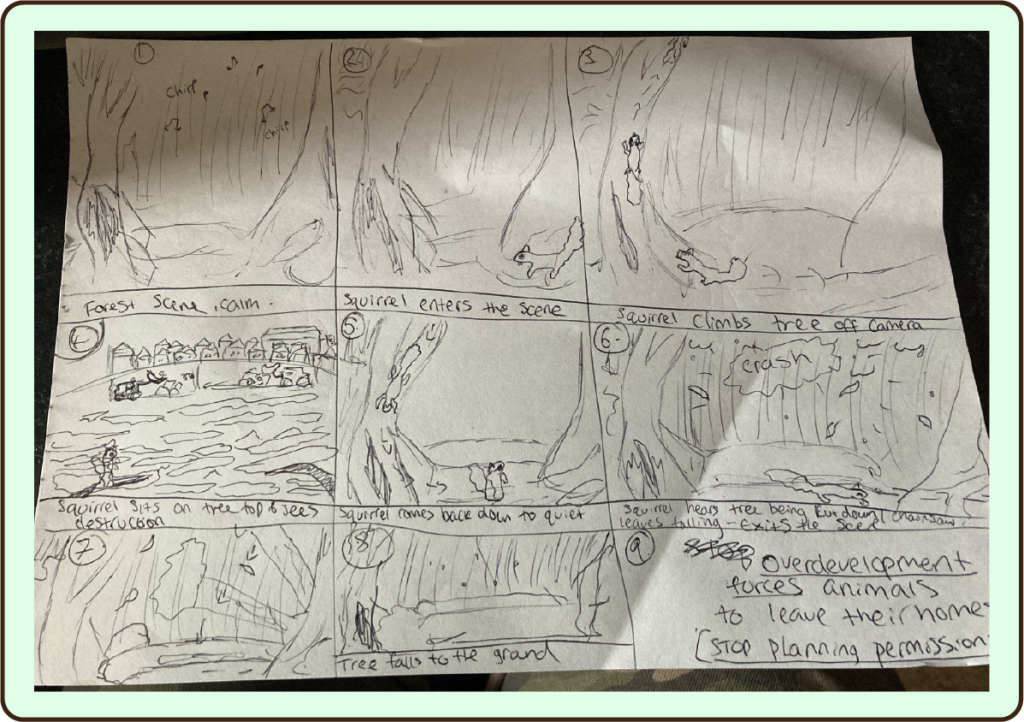
In this eight panel storyboard, I had the idea to have a hand painted background, with the journey of a squirrel within a woodland scene. Panel one shows the woodland scene in harmony, with panel two introducing the squirrel onto the scene from the side; i then wanted the squirrel to go up a tree so that i could have a treetop landscape view, where the trees hit a clearing showing a building site, and newly built houses, as well as diggers moving along being destructive. Following this, the squirrel becomes spooked by the sounds of the machinery, and it then comes back down onto the woodland floor, only to be further disturbed by sawing sounds of trees being cut down, and leaves falling around it, causing it to flee the scene. The last panel shows a slide with text on it protesting overdevelopment.
I decided to do away with having a tree falling at the end because I had put in a lot of work already into the painting and I needed to be savvy with my time.
The Artistic Process
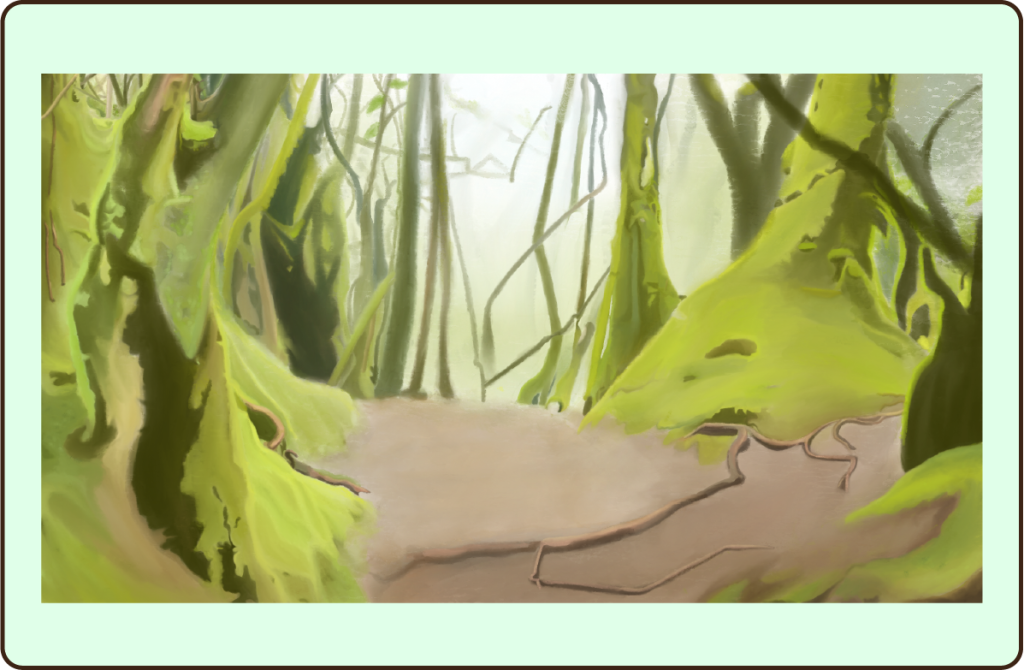
This painting took me around 43 hours in total to do, and I used a gouache brush and Procreate software to create a forest floor scene, using bright greens to show abundance of life and lush moss and foliage. I also painted a tree top scene for the squirrel to sit amongst and watch the destruction from, creating a juxtaposition of peace and machinery/building. The reference images I used will be within my Harvard references.
Visual Design Treatment
Chart Junk
Chart Junk, as defined by Tufte is “Chartjunk consists of all visual elements in charts and graphs that are not necessary to comprehend the information represented on the graph, or that distract the viewer from this information” Tufte, Edward R. (1983). The Visual Display of Quantitative Information.
The animation will reduce any chart junk by only having the one necessary background per corresponding scene, so that users can focus on the 2D animation at hand, and its message, without getting distracted by lots of transitions into backgrounds and scenes. In this way, it allows me to hand paint the majority of the backgrounds, which will take more time than using royalty free images; which allows me to tailor the style, colour, and scenery, without opting for quantity over quality.
Use Of Colour
Tufte also states on the use of colour: “The fundamental uses of color in information design (are): to label, to measure, to represent or imitate reality, to enliven or decorate.” (deadprogram (2010) Edward Tufte On Use Of Colour.)
I will use colour in my hand painted backgrounds to represent the planet, its multitude of greens, to convey beauty and awe of the sublime, to convey how we should care for our planet and the conservation of its environment and wildlife. In this way I will also be calling on the semantic memory of humans, to remember where we come from, our symbiotic relationship with the earth, and evoke imagery of the natural world such as trees, grass, plants, foliage and vegetation, as well as woodland.
Small Multiples
I think that small multiples can usefully translate to the overall story, information conveyed, and journey expressed through the small movements of the assets within my 2D animation along the animation timeline, expressed visually by graphical symbols, such as the tiny movements of the squirrels legs and paws, and head and tail, to show emotions, and to take the viewer on a journey through the eyes of another animal, which is the purpose of my video, to show people how animals are affected by the overdevelopment of rural areas.
Layering
Tufte describes layering as “Layering and separation is another important set of principles that can help reduce clutter and confusion in a data visualization.” (Blake Williford, PhD (2016) Information Design, Medium)
I will use different sounds and music, layered over the video to show the contrast between the quiet, serene beauty of the life of a squirrel amongst the forest, contrasted against the loud and mechanical sounds of destruction brought about by the building site, and the diggers in the animation. It will be utilised as an added extra layer of information,to help people understand the feelings and messages behind the animation, resulting in the desired outcome of understanding about the overdevelopment of the natural world.
Micros Macros
“We are accustomed to seeing the “big-picture” such as the view of the city below us when we fly in an airplane, as well as the “details” which could be those recognizable landmarks we drive by everyday like buildings and stadiums. When utilized properly it can help people understand concepts as well as have a powerful persuasive ability.” (Blake Williford, PhD (2016) Information Design, Medium)
It can be observed that during the animation, micros/macros have been utilized in the form of the juxtaposition of lots of trees in a tree top view scene, this is to convey the big and the small of the Earth, and to communicate with viewers in a way that they can understand, and in a way that we are used to understanding. As B.Williford states in the quote above, people are used to seeing the “big picture”, such as the view of a big city, whereas i use the tree top view of a forest, to show the dissonance between the natural world, and the houses and diggers on a building site, which i show in the background.
Relevant Animation History
Kazuo Oga
Kazuo Oga (男鹿 和雄, Oga Kazuo, born February 29, 1952, in Akita Prefecture, Japan) is an animator, art director and illustrator. He worked on numerous Studio Ghibli films, including My Neighbor Totoro, Only Yesterday, Whisper of the Heart, Porco Rosso and The Tale of the Princess Kaguya, and has worked closely with Hayao Miyazaki and Isao Takahata.”
I am inspired by his works of fantastical background paintings for Ghibli’s 2D Animations such as Princess Mononoke, My Neighbour Totoro, and Spirited Away. He uses layers of gouache and poster paints to create beautiful naturescapes, with a wide variety of greens, and he has been praised by Miyazaki, (film director and co-founder of Ghibli), for having a natural talent with the colour green (Ghibli Wiki Fandom (N.D.) Kazuo Oga, Ghibli Wiki, Fandom). His style of painting has inspired my style of painting, and is the reason why I decided to paint my own background scenes for my animation.
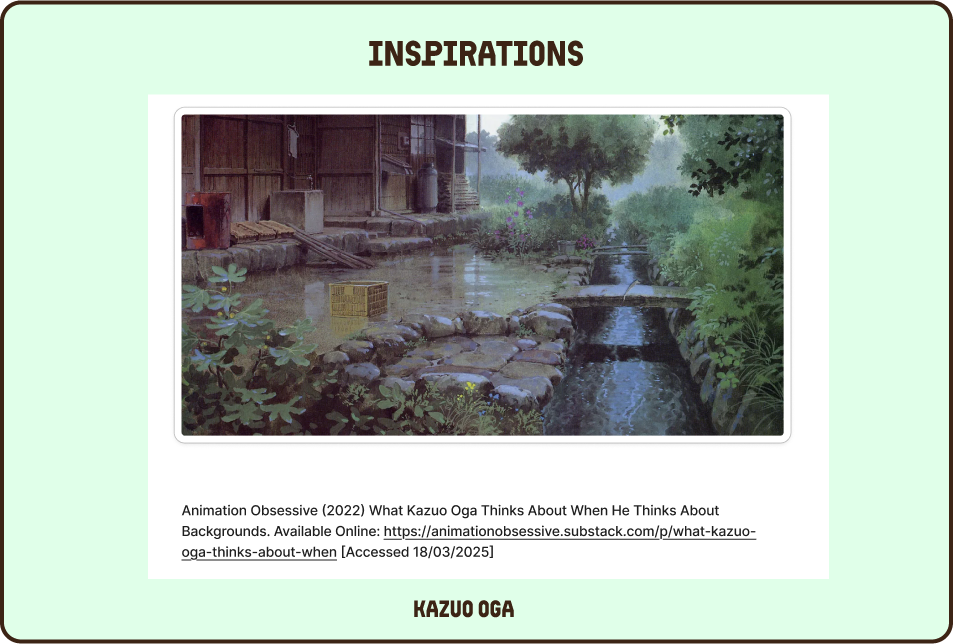
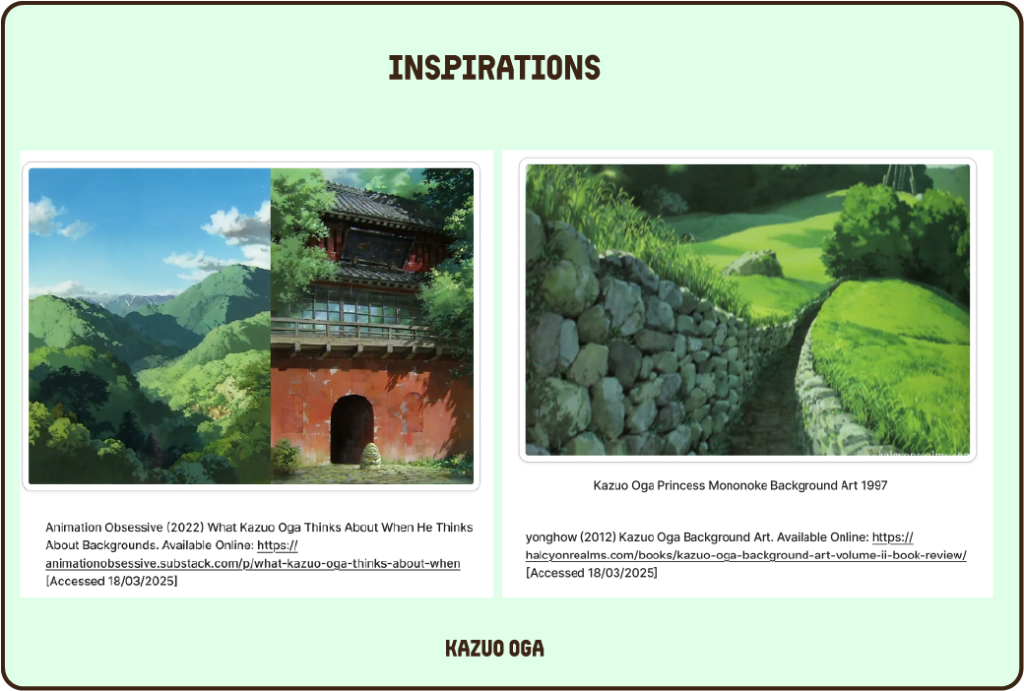
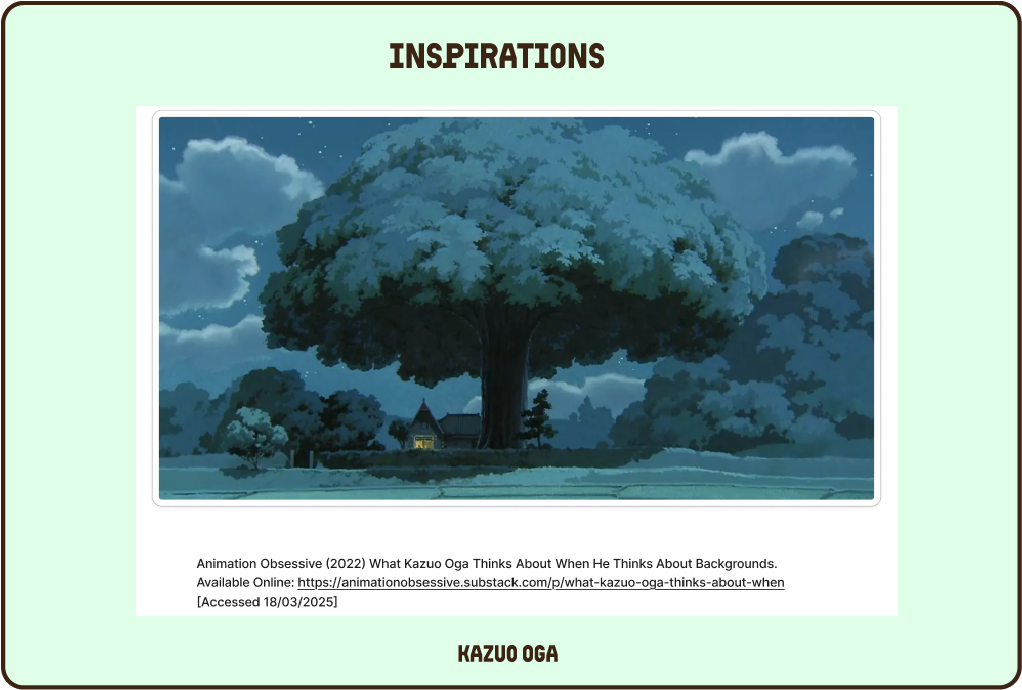
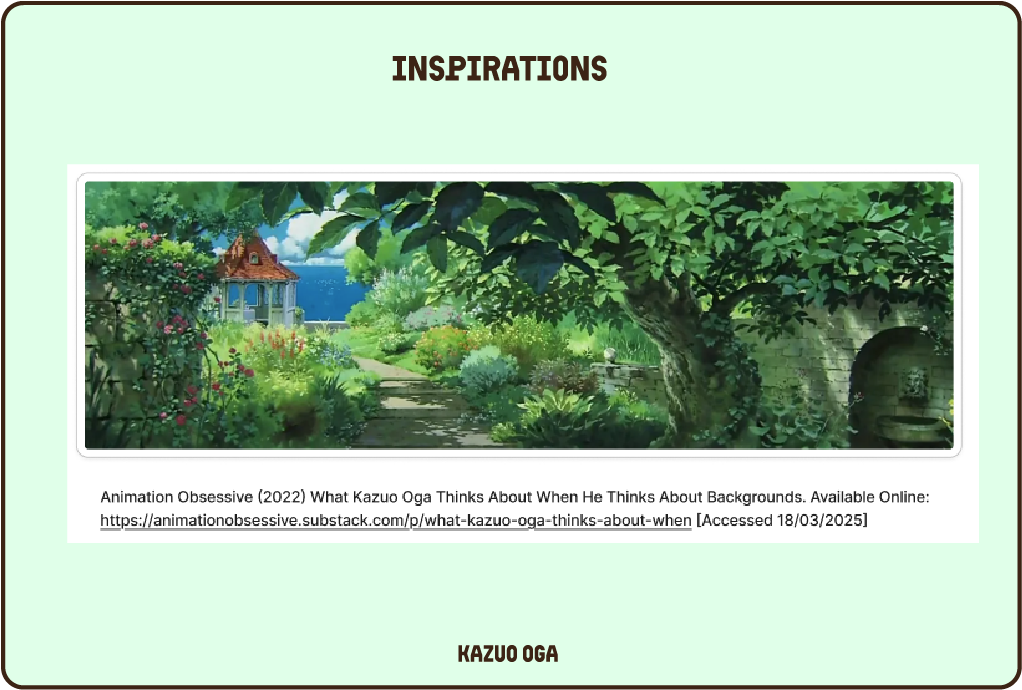
I think this animation is extremely beautiful and displays effective use of colour, in evoking semantic memory, (Tufte’s colour), and evoking feelings of awe in people. I will be using colour to display the natural habitat of my squirrel character and to show natural beauty as desirable.
I also think My Neighbour Totoro creates a sense of compassion for nature and animals, and creates a sensory experience through 2D animation, which I’d like to incorporate into my animation, in which the goal is to evoke compassion for the animals affected by overdevelopment.
These films all inspire me because of the hand painted backgrounds and the 2D animation. I love how the background art is all centered around the beauty of the natural world, and uses such vibrant greens to convey the dense plants and trees. I want to use my 2D animation as a way of conveying this kind of beauty, but in my own unique art style, as well as tell a story about the animals and how it is affecting them and their ecosystem.
Abi.Toads Instagram
My second inspiration for 2D animation is an Instagram account called abi.toads, which features an artist who uses hand painted animated backgrounds, and 2D toad and mushroom characters to show a humorous and whimsy natural world. The artist is extremely talented and has inspired me to create an animation of my own which uses hand painted backgrounds, with 2D characters. Her style is extremely reminiscent of Studio Ghibli which ties into my other inspirations also in a way that makes sense to the development of my project, and the visual style i want to convey.
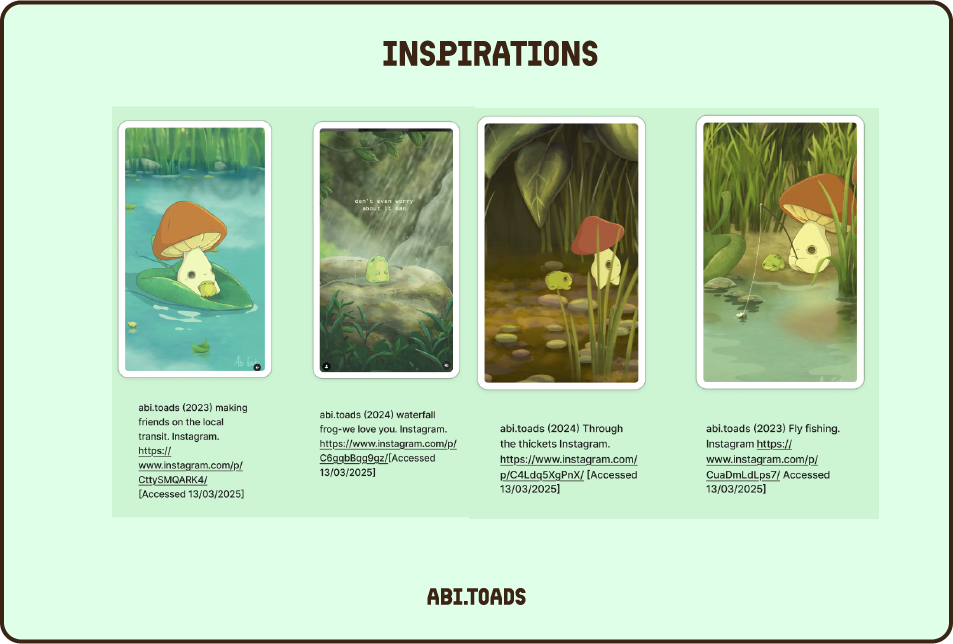
I think this animation style is heavily inspired by Studio Ghibli, and conveys the exact sort of natural wonderment that I would one day like to be able to achieve. She uses colour and painting to create beautiful thought evoking backgrounds, and combines them with 2D animated characters, which is the goal for my animation project.
Welcome To The Forest Floor
Harvard References
abi.toads (2022) A witch and her froggy friends Instagram https://www.instagram.com/p/CcVK3ThFYxz/ Accessed 13/03/2025]
abi.toads (2022) Dance of the fireflies Instagram https://www.instagram.com/p/Ce6HPo3gtm2/ Accessed 13/03/2025]
abi.toads (2023) Fly fishing. Instagram https://www.instagram.com/p/CuaDmLdLps7/ Accessed 13/03/2025]
abi.toads (2024) Through the thickets Instagram. https://www.instagram.com/p/C4Ldq5XgPnX/ [Accessed 13/03/2025]
abi.toads (2023) making friends on the local transit. Instagram. https://www.instagram.com/p/CttySMQARK4/ [Accessed 13/03/2025]
abi.toads (2024) waterfall frog-we love you. Instagram. https://www.instagram.com/p/C6gqbBqg9gz/[Accessed 13/03/2025]
AudioPapkin (N.D.) Forest Ambience Royalty Free Music. Pixabay. [Download] Available Online:https://pixabay.com/sound-effects/forest-ambience-296528/ [Accessed 26/04/2025]
AudioPapkin (N.D.) Free Chopping Down Tree With Chainsaw Sound. Pixabay. [Download] Available Online:https://pixabay.com/sound-effects/chainsaw-297887/ [Accessed 26/04/2025]
antique98 (Freesound) (N.D.) Construction Site With A Tractor Royalty Free Music. Pixabay. [Download] Available Online: https://pixabay.com/sound-effects/construction-site-with-a-tractor-34145/ [Accessed 26/04/2025]
Edward Tufte. Medium. Available Online: https://medium.com/@blakewilliford/information-design-9-29-ee995efb584e [Accessed 26/04/2025]
deadprogram (2010) Edward Tufte On Use Of Colour. Available Online: https://gist.github.com/deadprogram/782074 [Accessed: 26/04/2025]
Ghibli Wiki Fandom (N.D.) Kazuo Oga, Ghibli Wiki, Fandom. Available Online: https://ghibli.fandom.com/wiki/Kazuo_Oga [Accessed 18/03/2025]
Hephaestus (Freesound) (N.D) Whisper Of The Wind. Pixabay. [Download] Available Online: https://pixabay.com/sound-effects/whisper-of-wind-74137/ [Accessed 26/04/2025]
ItsMikke (2024) THE BEAUTY OF MY NEIGHBOUR TOTORO. Youtube. Available Online: https://www.youtube.com/watch?v=WWoflMmxb_Y [Accessed 26/04/2025]
matt_beer (Freesound) timber tree falling 1 royalty free. Pixabay. Available Online: https://pixabay.com/sound-effects/timber-tree-falling-1-40384/ [Accessed 26/04/2025]
Rory (2014) Mossy Forest Tour in Malaysia. Planet and Go. Available Online: https://planetandgo.com/mossy-forest-tour-malaysia/ [Accessed 02/04/2025]
𝐓𝐡𝐞𝐨𝐭𝐚𝐤𝐮𝐛𝐨𝐲 28 (2022) Beautiful Ghibli Scenery Princess Mononoke. Youtube. Available Online: https://www.youtube.com/watch?v=XuvZpHTacjM [Accessed 26/04/2025]
Tufte, Edward R. (1983). The Visual Display of Quantitative Information. Cheshire, CT: Graphics Press. [Accessed 26/04/2025]
The Studio Ghibli Collection Presented By GKIDS (N.D.) Filmography. Available Online: https://ghiblicollection.com/pages/filmography. [Accessed 24/04/2025]
Very Informative (2017) Kazuo Oga Painting In Poster Colour Ghibli Studio Anime Background. Youtube. Available Online: https://www.youtube.com/watch?v=FTZhMGMe3SU [Accessed 26/04/2025]
Warm Chords Loop (N.D.) Warm Chords Loop. Pixabay. [Download] Available Online: https://pixabay.com/sound-effects/warm-chords-loop-240903/ [Accessed 26/04/2025]
Wayne C. Zipperer, Robert Northrop, Michael Andreu (2020) Urban development and environmental degradation. Oxford Research Encyclopedia of Environmental Science. https://doi.org/10.1093/acrefore/9780199389414.013.97
Wildlife Trust Wales (N.D.) How Wildlife Can Be Harmed By Development. Available Online: https://www.wtwales.org/how-wildlife-can-be-harmed-development [Accessed 30/03/2025]
Yorkshire Wildlife Trust (N.D.) Planning YWT. Available Online: https://www.ywt.org.uk/planning-and-policy [Accessed 26/04/2025]
Yorkshire Wildlife Trust (N.D.) YWT Addressing Wildlife In Neighbourhood Plans (pdf) Available Online: https://www.ywt.org.uk/sites/default/files/2024-05/YWT%20Addressing%20Wildlife%20in%20Neighbourhood%20Plans.pdf [Accessed 26/04/2025]